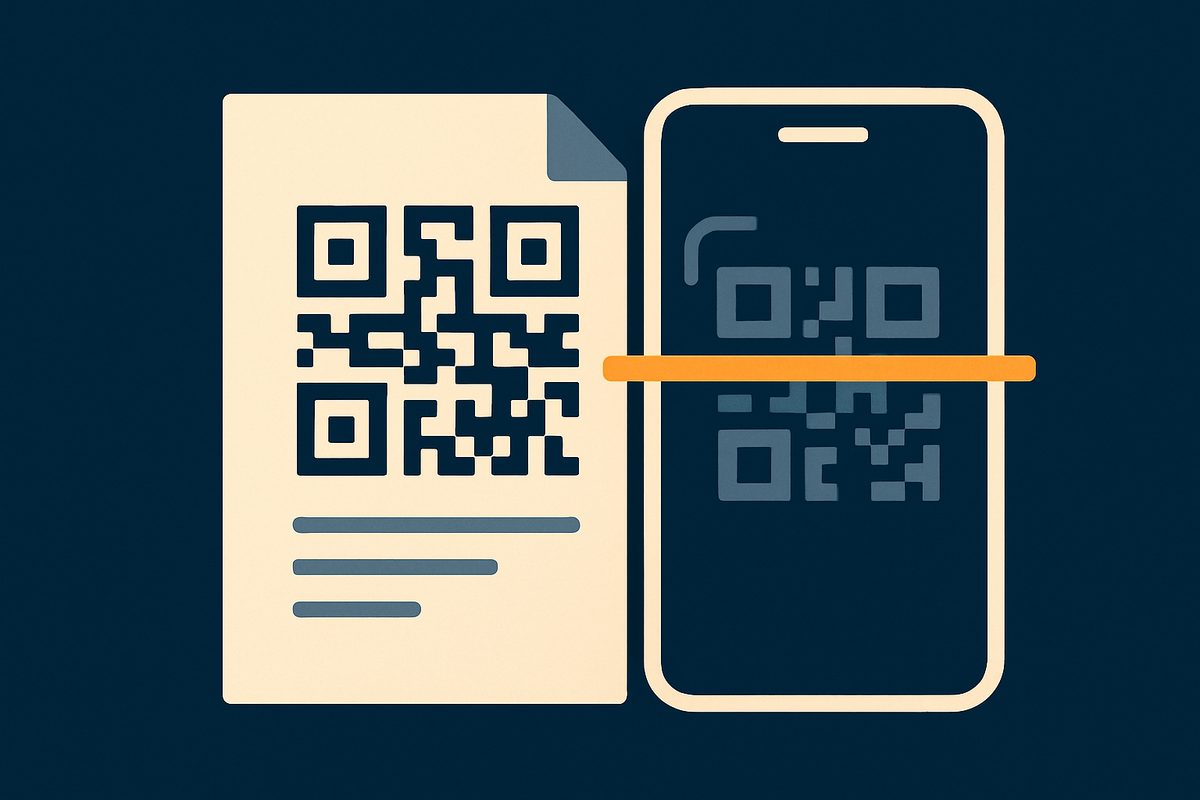
Every FBR digital invoice carries a QR code because it encodes the invoice reference number FBR returned on acceptance, together with the seller's registration details and enough information to match the code to one specific accepted invoice in FBR's system. It is generated fresh for each invoice, so an invoice with no QR code was either never submitted to FBR or was submitted and rejected.

What is actually in it
Scan one and you get back the core facts of the sale: the seller's registration details, the invoice reference number FBR issued, and enough information to match the code to a specific accepted invoice in FBR's system. It is not a marketing code or a generic logo, it is generated fresh for each invoice, tied to that one transaction.
Who actually scans it
In practice, three groups care about this code. FBR's own field teams can scan an invoice during a spot check and confirm on the spot that the sale was reported, without waiting for a return to be filed. Buyers, particularly larger businesses claiming input tax, increasingly check that a supplier's invoices are genuinely FBR invoices and not just formatted to look like one. And you, the business issuing the invoice, have a fast way to prove to anyone questioning a sale that it was reported honestly and on time.
Why it is mandatory now, not optional
Before real-time reporting, the honesty of an invoice was checked long after the sale, during an audit, by which point records could be incomplete or hard to reconstruct. A QR code tied to a live FBR record removes that gap. The invoice proves itself the moment it is printed, instead of needing to be proven later. That is the whole shift behind SRO 69(I)/2025 and the digital invoicing rules that followed it: verification moves from after the fact to the moment of sale.
If an invoice does not have one
No QR code generally means the invoice was never submitted to FBR, or was submitted and rejected. Either way, treat it as unreported until it is fixed and resubmitted. This is different from a QR code that looks unusual or low resolution on a printout, that is a printing issue, not a compliance one, and the underlying data is still valid as long as the invoice reference number is correct.
A QR code on every accepted invoice, automatically
Axiom Square submits each sale to FBR, then prints the QR code straight onto the invoice the moment it comes back accepted. No separate step, no manual generation.
See Axiom SquareGeneral information, not tax advice. Confirm specific requirements for your business with your tax consultant.
Common questions
What is actually inside an FBR invoice QR code?
The core facts of the sale: the seller's registration details, the invoice reference number FBR issued on acceptance, and enough information to match the code to one specific accepted invoice in FBR's system. It is generated fresh for every invoice.
Who scans the QR code on an FBR invoice?
FBR's own field teams can scan an invoice during a spot check and confirm on the spot that the sale was reported, without waiting for a return to be filed. Buyers, particularly larger ones, are the other group that checks it.
Why is the QR code mandatory rather than optional?
Before real time reporting, the honesty of an invoice was checked long after the sale during an audit, by which point records could be incomplete or hard to reconstruct. A QR code tied to a live FBR record removes that gap.
What does it mean if an invoice has no QR code?
Generally that the invoice was never submitted to FBR, or was submitted and rejected. Either way, treat it as unreported until it is fixed and resubmitted. That is a different situation from a code that merely looks unusual or prints at low resolution.